Showing posts with label marketing basics. Show all posts

Customer Service: why it matters and 10 key skills

 Customer service

Customer service is a vital component of the consumption experience to any firm who wants to retain customers and grow their business. 

Great customer service means customers are likely to come back, but a subpar experience means they are unlikely to come back. 

What Is Customer Service?

Customer service is the support provided by a firm or brand to the customers or potential customers of their product or service. It can happen before, during or after customers purchase or use a product or service. Firms aim to meet the needs, desires and requirements of these customers through delivering professional and supportive and assistance, to ensure an easy and pleasant consumption experience.

Customer service can be face to face in a store, over the phone, through digital activities such as text, social media messaging or email, or by automated means such as an ATM. This interaction between a service organisation and its customers or clients is referred to as a service encounter and a firm has the opportunity to form an impression with customers every time they come into contact.

“Interpersonal interaction between an organisation’s employees and its customers… have a high “impact” on the consumer and the quality of the service encounter… thus a vital ingredient in the overall quality of service experienced by the customer.” (Lewis & Mitchell, 1990)

Why is customer service important?

Customer service is part of the promise brands give customers. There is now an expectation from customers that businesses provide a certain quality of customer service. This is especially true in the services industry. Even the local mechanic now needs to step up their game. Businesses need the ability to learn, identify and adapt to the needs and wants of consumers. Customer-oriented firms have a higher ability to anticipate the developing needs of consumers and respond with goods and services.

Customer service that is at least on par with competitors is critical to competing effectively. If it is better, it can give you a competitive advantage. Customers do not shop based on price as often as they used to. Instead, their overall experience is often the motivator.

“89% of companies now expect to compete mostly on the basis of customer experience.” (Gartner Research, 2014)

It is cheaper to keep existing customers than to acquire new ones. But it is not as simple as just having great products to retain them — your customer service needs to be on point. Bad customer service is enough for previously loyal customers to choose a competitor — if customers are not happy with the service, chances are they will leave.

The benefits of great customer service

Providing customers with an elevated level of service quality has a positive relationship with brand performance and customer satisfaction. Service quality is how well the delivery of that service matches customers’ expectations. Satisfaction has a positive relationship with repeat purchase, and this is particularly true for service industries. Customers are satisfied when a firm performs better than they expected.

Prioritising customer service support might increase the costs of a firm through needing extra staff or tools/technologies, but there are a few benefits that should outweigh the investment. Studies have indicated that over 80 per cent of people would pay more for better customer service.

Some other benefits of providing great customer service include:

  • customers are more satisfied with their experience
  • enhanced perceptions of the firm’s overall market strategies
  • increased positive word of mouth and referrals attracting new customers
  • increased customer loyalty and repeat purchase
  • increased ability to upsell or cross-sell relevant services
  • customers can be willing to pay higher prices for a better experience
  • customers perceive products and services as having better quality
  • customers perceive the servicescape as being of higher quality

The customer service of a firm or brand can ‘make’ or ‘break’ their reputation.

“…Organisational culture that stresses the customer as the focal point of strategic planning and execution…  Employees consistently exhibit customer-oriented behaviours, and consumers thereby become accustomed to this philosophy.” (Brady & Cronin Jr, 2001)

Having somebody yell through the phone line is nothing new to customer service representatives

Bad customer service

In the world of mobile phones and social media, it is hard to hide a bad customer experience. People can quickly share a negative experience online, which can reach a large audience. With many people using Google search to check out a business, a couple of bad reviews can make a significant difference. People are more likely to share a negative experience on social media or talk about it with their friends than they are with a positive experience.

How can firms improve their customer service?

Improving customer service means making every touchpoint great and not letting any interaction fall between the cracks. There must be consistency across the organisation in providing a great customer experience.

In 2020, it is not enough for firms to only use the traditional means of customer support such as over the telephone for customer support. Customers expect to be able to reach organisations by whatever means they find convenient, whether it is email or social media. Therefore, firms must have a comprehensive approach and provide a range of customer service options to customers.

Businesses can also provide self-service support to customers so they can find the answers they require without needing to deal with customer support staff.

A customer orientation

Marketing has progressively moved towards a customer orientation since Leonard Berry’s seminal writing on Relationship Marketing (1983), now considered a fundamental principle of marketing. To be customer-oriented implies that a firm focuses on the customer as the centre point of their strategic planning and execution. They aim to identify and adapt to consumers’ needs and wants as a competitive strategy through learning from customer perceptions of their experience.

“Having a customer orientation has a positive influence on customer perceptions and, ultimately, the performance of firms.” (Brady & Cronin Jr, 2001)

A customer’s evaluation of the overall service quality is determined by three factors: employee service performance, physical goods/service quality, and servicescape (place of business) quality. Firms must be proactive in collecting and analysing customer data for a better picture of how they are performing and the needs and wants of customers, and to act on this information.

Digital tools for customer service

In the digital age, consumers now have several methods available to communicate with customer service representatives.

Over the past few years, social media has become increasingly popular to request and receive customer service. It is an expectation now to be able to send a message via a major brand’s Facebook page with any questions or problems you may have related to their products or services and receive a prompt response. Around half of the internet users now turn to social media for help. Accordingly, many large organisations implemented dedicated customer service teams to respond to social media messages. Studies (see Xu, Liu, Guo, Sinha & Akkiraju, 2017) have indicated that users who message a brand’s Twitter account expect a response within an hour.

This consumer demand for an instant response and the time-consuming nature of manually addressing these requests lead to the rise of AI for customer service on social media. This led to the creation of chatbots to automatically generate responses for user requests on social media and now on websites. These chatbots provide an opportunity for brands to provide individualised attention to consumers.

“Marketing is concerned with exchange relationships between the organisation and its customers. Quality and customer service are key linkages in this relationship.” (Christopher, Payne & Ballantyne, 91)

A genuine smile goes a long way in customer service
A genuine smile goes a long way in customer service 

Key customer service skills

As much as a firm can have a customer orientated strategy, much of the responsibility for great customer service falls on the staff members. Luckily, customer service is a skill that people can learn and develop, rather than a personality trait you either have or you do not.

Here are ten customer service skills that are key to providing great customer service.

1. Patience

Patience is vital for anybody with customer service in their role. From real estate sales to a check out operator at a supermarket. Customers who reach out to support are often frustrated and at their wit’s end. Sometimes they want to vent. There could be a simple solution, but let the customer get it out of their system. For example, a study found that 40% of user requests on Twitter are emotional and not intended to seek specific information. Empathy goes hand in hand with patience, which is a person’s ability to understand another person’s feelings. A staff members ability to see an issue from the customer’s point of view is a huge advantage and customers appreciate it.

2. Listening

The ability to truly listen is not only a key skill for customer service but life in general. Listening allows you to fully understand the customer’s point of view and solve their problem. When you do not listen, it is easy to get it wrong and create a frustrating experience for the customer. Customer service reps can often jump to conclusions about a solution, which can come across as rude and brash. Take time to listen and understand customer issues, it will show you value their needs.

3. Communication

It might sound obvious, but how you communicate with customers is key to their experience. You do not want to come across as condescending, grumpy or rude — this will translate into a negative experience. It is important to be mindful of how staff communication comes across. As well as attitude, the clarity of the communication during customer service is key providing the right outcome. The last thing you want is more confusion on the part of the customer because they do not understand what they are supposed to do or what the solution is.

4. Learning

By learning about the issues and concerns of their customers, so they can provide a solution. How do we learn from our customers? By asking questions and listening when interacting. The more your customer service staff know about your customers’ needs, the more of an asset they are to both the organisation and the customers.

If the same customer issues come up consistently, chances are you have not learnt from this to provide an adequate solution. Staff must communicate these issues to management so they can plan to resolve the problem. If your customer service team is working like a well-oiled machine and learning from the feedback, you will start anticipating problems instead of just solving them.

5. Time management

Customers often expect a resolution as quickly as possible. They hate to wait — especially over the phone, so long waiting times can negatively affect customer experience. So, whilst patience and taking time with customers is important, there is a limit to how long you should commit to each customer. Firms should provide customer service employees with the information and tools to support their customers are as quick as possible. Staff training can help improve resolution times.

Customer service representative on the phone

6. Composure

Customer service staff must have the ability to stay consistently calm under pressure, even if they are experiencing difficulties with an upset customer. This cool demeanour can help calm down the customer and keep the conversation as objective as possible to find a resolution to their issue. Emotion triggers many of the interaction customers have with customer service, so it is key for staff to remain level-headed — even when customers are being insulting to them or their firm. The staff that can think on their feet are a huge advantage — not every interaction will be in the training manual. Expect the unexpected.

7. Negotiation

Often staff members will need to negotiate with customers to find a resolution. Conversations need to end with a solution and/or with the customer feeling that the firm have (or will) taken care of their needs. Negotiation is not arguing — it is important to remain calm and have a constructive conversation. There will always be one party who feels like they have come out better off than the other party — make sure that is the customer! Do not just give in to the customer demands, there must be some give and take. Customer service staff require good persuasion skills when there is no obvious solution, this reasoning can help convince the customer of a suitable outcome.

8. Teamwork

Teamwork and customer service go hand in hand; both staff and customers will benefit when customer teams work together as resolutions to the customer issues are faster. One customer service representative will never have all the answers, so there must be open communication lines across teams to find a solution to each unique issue. Large firms often have several dedicated customer service teams for different requirements. There might be one team for technical support, another team for accounts and billing, and another team for general inquires. In smaller firms, provide all employees with some customer service training so they can help when required.

9. Positivity

It can be a challenge for customer service staff to spend their days dealing with customer complaints and negativity that comes along with the role. However, it is a key customer service skill to remain upbeat and positive. If staff meet customers with a smile and a cheerful attitude, it makes customers feel a lot better. This can put staff on the front foot when trying to find a resolution. It also creates a better work environment. If staff are happy and they can feel other staff are happy, they enjoy their jobs more and become more productive.

10. Product & brand knowledge

The more your sales staff know about your product or service, the better they are at selling them. Similarly, with customer service, the better staff become at providing a solution. Training should be a key part of customer support. Many large companies onboard every new employee to ensure they know their products inside and out. Onboarding is the process of integrating new employees into an organisation, familiarising them with the products and/or services. The best customer service staff have intimate knowledge of how their products work or order to find each customer an adequate solution to their problems.


In summary, this article has explored how great customer service can positively influence the performance of a firm and 10 key skills for customer service staff. 

I hope you enjoyed this week’s content and learnt some new tips and strategies for improving your firm’s customer experience.

Ten networking tips to help boost your career

Networking is a powerful tool for business people to meet relevant people that can help them further their career, whether it is a new job or new clients.  As they say, "It's not what you know but who you know."

Business networking event

What Is Business Networking?

Business networking is the act of interacting and conversing with other people to develop professional contacts and exchange information, usually in the setting of an event or meeting. Networking helps individuals to establish and nurture long-term and mutually valuable relationships, popular with career-focused professionals.

The aim is usually to expand one’s circle of influence and acquaintances to enhance opportunities to further one’s career — whether it is a new job or promotion or to meet potential future clients, customers or business partners. Invest time (and a little bit of money) into increasing your networks and relationships — personal and professional, and in the long-run, you will reap the benefits.

Although we often have individual goals, we should not forget that networking is for mutual benefit. If you want to further your career opportunities, you should be networking. Opportunities to network exist all around us. At the supermarket. At the gym. Picking up the kids from school or watching them play sport, or at religious gatherings. We should not neglect our networks as an opportunity to grow our business network. As they say, it is not what you know, but who you know.

Growing your networks will help you establish rapport and trust in your local community, so look for opportunities to network strategically. Consider locations where you are likely to meet new people with common professional or personal interests, and where you feel comfortable. Volunteering is one way to meet people and put yourself in a positive light, whether its coaching or for a local community group.


Business networking events

There are several options out there for business networking, this section will cover a few of those options to help you choose what might be best for you. There is not a “one size fits all” for networking — different settings and strategies will suit different people.

Try different networking events to see what is more comfortable for you. Do you like busy open networking events with noise and atmosphere, or would you prefer a sit-down coffee group with a dozen or so people, each taking a turn to talk? Whether you have introvert or extroverted characteristics will influence how comfortable you are in a certain setting.

Once you have worked out what type of networking setting suits you best, think about where you can meet the right kinds of people to help you further your career.


Chamber of Commerce

If you join your local Chamber of Commerce, often they have a range of events set up for their members. The goal of a Chamber is to help promote, support and encourage sustainable, profitable business growth in the local community for its members. Often, they run events once or twice a month where there are designated speakers on a particular theme, and there is a networking portion of the event.


BNI

The BNI group (Business Network International) is one of the most well-known and popular networking groups for business professionals. BNI is an American model franchised around the world, boasting over 270,000 Members in 9,500 Chapters worldwide. They call themselves “the world’s leading business referral organisation”. They are often very structured, and members meet weekly or fortnightly, usually over breakfast. There are a large emphasis and expectation to provide referrals for other members and because of this there is a membership fee to be a member, and typically only one person from each profession can be a member of each chapter.

Many of the networking skills discussed in this will not apply as this format is so structured and everyone gets a turn to talk about themselves and what they do.

Coffee networking group

Coffee groups

Coffee groups are a fantastic way to build relationships with people over a period. You could consider starting your own, set up through a Facebook or LinkedIn group, or your local mailing list. I run a local coffee group who meet once a month on the same day, time and location, to make it easy to lock into the diary. Everyone gets 30 seconds or so to give their elevator pitch and then we all have informal discussions with the people next to us, or sometimes as a whole table (inevitably with 10–15 people, smaller conversations break out). There is no fee to attend and no obligations for referrals like a BNI, so it has quite a relaxed feel. Once you build trust with people, referrals will naturally come.


LinkedIn Local

LinkedIn Local is a business networking event set up to leverage the growing popularity of LinkedIn and its professional networks. It is in over 1000 cities around the world, and the format is dependent on the individual event and its host. Some events are small coffee group type gatherings or at a bar, and some are more large scale in a specific events space. I run one called

LinkedIn Local Hamilton networking event


The benefits of networking

A strong professional network can have many benefits that can influence the success of your career and growth. Here are some of the benefits you will receive through planned and regular networking.


Career development

The overall goal for most people who attend networking groups is the evolution of their career. Some of those people might have a specific goal of short-term sales or to meet a certain person or type of person, but these goals all work towards the grand vision of being more successful in life and business.

People used to have jobs. Now people have careers. In an ideal world, more businesses would emphasize the professional development of their staff, but it is usually up to the individual to further their career. The average life span for a job is five years, even less for those under 35. Career-focused individuals often have an eye or ear out for better opportunities to further their careers.


Opportunities

Developing your career is a long-term game, and consistently networking will open many new doors for opportunities.

If you are a good networker, you will find opportunities to connect with different people everywhere you go. You could meet people who end up being a mentor to you or build a stronger relationship with somebody from senior management in your workplace. Do not dismiss the workplace as an opportunity for networking. Often large workplaces have an end of week or end of month drink, could be beneficial to your career progression.

You could also use environments such as after school sport when you chat with other parents as an opportunity to improve your soft skills and you never know where opportunities come from. It is all about building relationships with relevant people consistently over a period

For those people who have recently lost a job or have just finished their study and are looking for a professional role, networking is the perfect opportunity to put yourself out there to grab any opportunities. You never know who you might meet who could be hiring or can give you a lead or referral which lands you the role you desire. They might just connect you with the right people. Networking helps you watch the local job market.

Just like it can help you find a new job; networking is a great environment to meet clients. There more people you meet who know what you do, the more likely you are to find new clients who want to engage you. Whether it is directly or through referral because of the trust you have built through networking.


Increasing your local profile

If you have been to a networking event before, you have probably noticed that there seems to be somebody who knows everybody. Chances are, they are probably regular on the local networking scene. Professionals can leverage networking to increase their profile. When you become well known and well respected with many people, this increases their general awareness of what you do and your expertise, leading to more business opportunities.

Networking event — LinkedIn Local Hamilton
Networking event — LinkedIn Local Hamilton
“Every man I meet is my superior in some way. In that, I learn of him.” (Carnegie, 1936)

Exchange ideas & knowledge

Networking is the perfect opportunity to learn. Therefore, a key skill to have as a networker is the ability to listen, as people who are strong networkers often exchange valuable information that is not public and only gained through conversation.

Whether it is keeping up with general current affairs, local news or industry knowledge and trends; the ideas and information gained from networking can help a career move forward. This sharing of knowledge also helps cement relationships by enhancing your credibility and mutual trust. Networking is a two-way street, so do not underestimate what value you can provide through sharing your knowledge.


Boost your confidence

Networking will help you develop and improve your soft skills which will increase your confidence to start conversations with new people. This increased self-esteem can be beneficial in the workplace when having conversations with senior staff members, or in your next job interview. Without having to consciously think about it, your body language will be a lot more positive from this self-belief.

Students often have not had many conversations with working professionals and once they leave their bubble of student life they can be a little nervous in job interviews or networking for the first time. It can be daunting. Actively trying to interact with professionals in your industry to gain networking experience and confidence can really set you apart from your peers in the job hunt.


Networking skills

Although it seems like great networkers are naturals, and often extroverts can be, it is just as much a skill learned and acquired. Here are ten networking skills or tips that you can use to become better at networking.


Have a plan

The first thing you can do to improve your networking is to have a plan. I must admit, when I first started networking, I had no idea what I was doing and would stand awkwardly in the corner and get nothing from it. Building a network is just like any other goal you have in life, and therefore, you need some sort of plan on how to achieve this goal.

Often people uncomfortable with networking view it as a work activity, which can make it seem quite loathsome. This mindset will not put you in the right frame of mind for networking. If you link networking with a higher goal, you will come into it with a much more positive mindset.

Whilst you do not need a specific goal for each event like I have to talk to X person, it is important to plan what you want to achieve so you increase your chances of meeting the right people. Choosing the right events to attend can define your success at a networker. Having broad goals for each event such as meeting with three people in your industry and knowing what actions you need to take.


Find familiar faces

If you are feeling uncomfortable and anxious about networking with people you do not know, look for people you are familiar with and join their group. It might be work colleagues or people you have met briefly previously. If you start here, you are likely to meet new people through them introducing you to people they know. You will also grow in confidence and after a while, you will get a feel for the atmosphere and should grow enough courage to approach other groups.

Networking event
Networking event

Find other people who are alone

If you cannot spot anybody that you know, try and find other people that are there alone. Chances are that they are feeling just as awkward as you are! Not everybody who attends networking events are seasoned pros. Often there will be many people such as yourself who are new to networking or new to the area.

Approach them in a light-hearted way and ask if they are there alone too, and how it is awkward to not know anybody there when everyone else seems to know each other. You will probably share a laugh and their walls will come down and you might have a really enjoyable conversation. Other people might notice this and come and join you.

Position yourself near the bar if you are alone and looking for somebody to chat to. The worst thing you can do is try and capture people as they walk in. Chances are they are tired and or hungry after work, and the first thing they want to do is grab a drink. They will be far more comfortable and ready to chat if they have just grabbed a drink.


Remembering names

When you meet a person or group of people for the first time, do you forget their names 30 seconds after the introduction?

I am the first person to admit I am terrible at remembering names. Unless I am focusing on remembering names, it is like they are instantly gone from memory. This is not going to help your networking very much, as it can be very awkward to not be able to remember somebody’s name and you might steer clear of them to avoid the situation. On the flip side, people love to hear their name, and it will leave a great impression if you remember their name and introduce them to someone else.

Luckily, remembering names can be a learnt skill. Try and attach a visual cue to a unique facial or body feature of each individual. If it rhymes, that will help even more. You might meet a guy called Henry or Harry who has a long beard. The visual cue that helps you remember his name could be hairy.


Body language

Body language can be a crucial factor at networking events of how many conversations you attract in the evening. Go in with a positive mindset and Smile! If you are uncomfortable, try not to focus on this. Your body language will reflect you are feeling awkward and people will feel this energy and will not approach you. Try not to look serious. Focus on happy thoughts and be open with your body language.

Smile at anyone who looks in your direction and say hello. Whilst engaging in conversation, the head tilt is a positive cue you can use to create rapport with the other person. This body language shows the other person that you are interesting, paying attention and listening. Everyone likes to be listened to!


Entering conversations

One of the most difficult things to do as a networker is trying to enter a conversation already in full flow. Especially if none of the people in the conversation knows who you are. Confidence is essential when networking, but do not go in, all guns blazing and interrupt a group conversation.

Instead, wait for your moment. It will make a bad first impression if you interrupt the flow of the conversation. Start by listening and then find a moment where you can add some value. If you can ask somebody a question, this is a soft way you can enter a conversation.

Listening to others builds them up. A lot of people at networking events love to talk about themselves. If you are not a confident networker, let other people lead the conversation. If you show genuine interest, nod in the right places and ask questions to find out more about their experiences and opinion, it will leave a great impression without you having to say very much.

“You can make more friends in two months by becoming interested in other people than you can in two years by trying to get other people interested in you.” (Carnegie, 1936)

Focus on learning

As discussed earlier, the benefit of networking is the exchange of ideas and knowledge. Therefore, part of your mindset when networking should be to learn as much as possible. Focus on learning instead of what you plan to get out of that specific conversation, you will come across in a positive light.

Approach networking with curiosity and an open mind about what interesting people you might meet. If you want to learn something new about someone, your conversation will seem far more authentic to the other person. You may have an interesting conversation that gives you new ideas leading to new experiences. Concentrate how networking helps you boost your knowledge and skills to further your career.


Identify common interests

Memorable conversations often begin with a point of common ground. Your kids go to the same school or you are members of the same sports club. The sooner you can identify any similarities you have, the sooner you will build rapport with that person and the easier the conversation will flow. This will be the starting point for an ongoing professional relationship. Consciously think about how your interests and goals align with the people you are meeting.

The easiest way you can do this is by asking questions to find out more about them. The conversation will feel far less forced and more authentic and meaningful, which will be a lot more memorable than the previous conversation they had about the weather. They will also appreciate the fact you tried to get to know them a bit better and might introduce you to others in their network with mutual interests.


Pay it forward

Do not make the mistake of looking at networking from the perspective of something you do just to get something out of it personally. If you look at networking equally as an opportunity to help others, people will recognise this and be more willing to help you. Introduce your network to each other if you think they can mutually benefit and look for ways to provide value to people.

The more you learn about your new connections the easier it will be to help them. It could be anything from a restaurant recommendation to introducing them to someone in your network. A great networker will know people with skill and expertise in all kinds of areas. If they cannot help them personally, they will know someone who can. They will both feel grateful toward you for bringing them together, giving you brownie points.

There is nothing worse than talking to someone at a networking event and the conversation cut rudely short when the other person realises there is no immediate benefit for them to gain from that conversation and they walk away to talk to somebody else. Do not be that person!


Following Up

Following up with somebody with mutual interest after meeting them at a networking event might sound obvious, but it is something that many professionals fail to do. People get busy and you can quite quickly become forgotten, wasting the hard work you did putting yourself out there. Following up reaffirms what you discussed, establishing your connection with them and opens future communication. Within a couple of days, send them an email (assuming you swapped business cards) or connect with them on LinkedIn with a personalised message, reminding them who you are and your conversation.

Do not follow up too strongly, you do not want to ruin your hard work by coming across as clingy or desperate. Once you connect on LinkedIn, you can stay in touch through wishing them a happy birthday or tagging them in articles that could provide value to them. Just stay relevant — do not be pushy!


That‘s this week’s blog. I hope you enjoyed this week’s content about networking.

Now go out there and meet some people!

Sales versus Marketing - different roles but the same goal

The two most essential elements for a business to create profit is sales and marketing.  It's key the two complements each other.  But often, they do not.  There is a lot of underlying conflict between the different orientations of sales and marketing.

Welcome to week seventeen of 50 Weeks of Marketing. This week we will explore the differences and similarities between sales and marketing, and how businesses can ensure these two processes do not contradict each other’s goals and instead, work for the common goal of profit.

50 Weeks of Marketing helps business owners to learn more about the foundations of marketing.

Sales Versus Marketing

Sales refer to the actions and activities of selling of goods and services, and a sales plan outlines the actions, tools, and resources required to reach your sales targets. Marketing is the process of putting your product or service in front of the people most likely to purchase it. A marketing plan outlines products, the price, what customers to target and the channels a chosen to best communicate with this target audience. There is some overlap, but they are two vastly different processes. 
“Marketing and sales are very often separate departments in organizational reality.” (Homburg & Jensen, 2007)

Isn’t marketing and sales the same thing?

Many people seem to assume that sales and marketing are one and the same. And if you are good at one, then you are probably going to be good at the other. In my experience, this could not be further from the truth. 

It is a completely different mindset and set of skills. The best salespeople I met whilst working in real estate (I am talking top 5 in the country) did not understand how marketing works. But they were always on the phone and were great at establishing and maintaining relationships. There were certain scripts they followed on phone calls. The best marketers would prefer to be sitting around, brainstorming ideas for content or talk about the positioning strategy of a random potato chips  brand —  they have no desire to get on the phone and cold call a sales prospect.

The biggest carryover besides trying to establish relationships — although both departments often do this in vastly diverse ways.
“Marketing has been characterized as more long-term oriented and sales as more short-term oriented, marketing as oriented toward products and sales as oriented toward customer relationships.” (Homburg & Jensen, 2007).
An analogy I like to use to explain the difference between sales and marketing is fishing. The goal of marketing is to throw a net out wide, to catch as many fish as possible. The goal of sales is to convert each of these leads, so I like to think of it as a fisherperson killing the fish when it is in their grasp, instead of letting it wriggle away and escape. The best salespeople can be ruthless!

The conflict between sales and marketing One of the biggest contrasts between sales and marketing is that marketing has traditionally focused on products, while sales focus on customers. Product focused marketing is based on planning and performance evaluations, where a customer focus is instead on forming and maintaining relationships.

An example of a time when the two approaches clash is when marketing want to remove and replace an unprofitable product, but sales want to keep the product as it is a good anchor product to start conversations and then try and upsell customers to another option.
“Intrafunctional conflict within marketing was a more important topic than we had expected. The most frequently discussed issue was the conflict between sales and marketing.” (Montgomery & Webster, 1997)
Many large businesses overestimate the influence their sales team has on revenue and can employ 10 or even 20 sales reps for every one marketer. It is even a common strategy for businesses to outsource marketing instead of doing it inhouse. In contrast, it is highly uncommon to outsource a sales team. Business often sees Marketing as an expense, where it should sit alongside a sales team and considered an investment. Like sales, marketing brings in revenue and performance can be measured to ensure an ROI. 

This lack of balance can bring resentment from marketers, contributing to the ongoing conflict. 


Some of the major contrasts between sales and marketing are
  • Marketing is trying to reach as many people as possible. Sales focus on one-to-one conversations. 
  • Marketing focuses on the big picture of the brand reputation. Sales focus on building and nurturing relationships.
  • Marketing has a long-term focus, requiring extensive planning to make each decision in the chain to give the customer what they want. Sales are short-term focused with targets, often requires immediate action, initiative and negotiation.
  • Marketing analyses mass amounts of data to review the average results and customer expectations. Sales deals with the unique characteristics of each customer and their desires. It cannot be averaged or quantified.  Each deal is different and it is a skill a classroom cannot teach.
“Salespeople accuse marketers of being out of touch with what customers really want… Marketers insist that salespeople focus… on individual customers and short-term sales at the expensive of longer-term profits. Poor coordination between the two teams… increases the cost of sales.” (Kotler, Rackham & Krishnaswamy, 2006)

A car salesperson

Sales

The sales process begins once a business has generated a customer lead. Then the sales team or process help that prospect move through their purchase decision. For example, if an advertisement got someone to visit a store, sales take over from there. Salespeople are responsible for managing customer relationships and solving their unique problem, resulting in a sale. Sales generate revenue. It is the bottom line.

In some cases, the sales team could uncover that lead through their prospecting, cold calling for example. Sales are very target focused and the process is driven to maximise the chance of converting a lead into a sale. A sales team will have a quota and volume goals, usually a target measured over a brief period such as a month or a quarter. 

Businesses often give bonuses as rewards to salespeople for reaching and surpassing targets. These incentivise the team to work hard and help the company reach its primary goals.

In sales, you’re often face-to-face with a customer (But it could be over the phone, or via email), trying to convince them to buy your product or upsell them to a more profitable product or service… “would you like fries with that?”

Great salespeople are key to the success of a business. They are good with creating rapport with people and thinking on their feet to provide a solution to any uncertainty. It is their job to reassure purchasers and give them peace of mind in their product or services with satisfying their requirements. Thus, resulting in a sale and ideally, repeat business.

Sales strategies include:
  • One-on-one meetings 
  • Cold calling
  • Networking 
  • Business events such as expos or conferences
  • Sales presentations 
  • Direct sales 
  • Business cards
  • Loyalty discounts
  • Abandoned cart emails 
  • Price negotiation 
A marketing team setting their strategies


Marketing 

Marketing promotes a brand as much as it does an individual product. Marketing encompasses the strategy and all activities that create interest and increase awareness of your brand and what you offer. 

Traditionally this meant using advertising to get your product in front of your target demographics. Now there are far more ways a business can reach and attract potential customers. Now the goal as marketers is to provide content that drives people to your website, and once they are, educating them about your offerings. 

Marketing strategy involves the collection of decisions to reach as many people as possible and to make your offering attractive against alternatives from competitors. Marketers use market research and analysis to gather knowledge better understand the interests of potential customers, to offer them the best solution. This market understanding gives businesses direction on products to make, who to sell to, what these customers want, and the competition. 

Marketing distinguishes the product from competition by choosing strategies such as where to sell the product, price, and packaging. This refers to a positioning strategy. It helps a business communicate effectively with their target customer segments. 

Marketing strategies include: 
  • Digital marketing such as social media, blogging and SEO
  • Print marketing 
  • Branding
  • Market Research
  • Public relations 
  • Product development
  • Distribution
  • Relationship marketing 
  • Branding 
  • Email marketing 
  • Pricing
Although their functions differ and cause some conflict, sales and marketing share a common goal to attract prospects or leads and then convert them into customers. Marketing changed over the years to align more with sales as businesses have realised, they need a cohesive system to convert as many leads into customers as possible and then retain them. A loyal customer is the best customer.

Trust is slow to develop. Usually, it takes several touchpoints between a buyer and a brand before they are ready to make a purchase. These touchpoints can be marketing, or sales focused.

The traditional view is that marketing takes responsibility for the top of the marketing funnel, and sales take care of the bottom. The reality is, there is a lot of overlap in the middle, and even at the bottom. Everything should have a long-term goal of retaining a customer and continue marketing to them to keep your brand relevant. Marketing has taken a leaf from sales and a customer orientated marketing focus now very key in 2020. Sales and marketing need to become a cohesive partnership with overarching goals and initiatives.

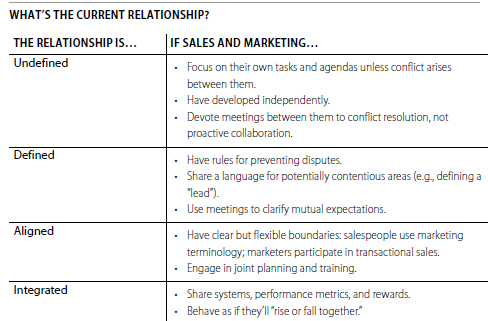
In 2006, Kotler, Rackham & Krishnaswamy discuss a need for businesses to have an integrated approach (see table below). They recommend businesses align and integrate sales and marketing to work together and reduce the conflict to achieve the best result. 


The relationship between sales and marketing
Relationship between Sales & Marketing teams — Kotler, Rackham & Krishnaswamy (2006) 

Sales and marketing teams should align their efforts by taking steps such as: · Regular meetings between sales and marketing to discuss problems and opportunities. · Defining who is involved in what decisions and if consultation is required. · Creating opportunities to integrate teams and for sales and marketing to collaborate on joint projects — for example, hosting industry events. · Having marketers help develop sales tools to qualify leads and take feedback from sales to target new market segments and refine offerings. · Having defined and shared key metrics to analyse and reward the performance of both teams such as sales goals both teams commit to.

Email marketing is an example of where sales and marketing goals overlap. Marketing such as a Facebook advertisement generates a buyer lead and sends the prospect to a website for a free eBook for example, which requires an email address. Here emails can have a different tone depending on whether the buyer is ready to go, or in the information search phase. 

Put buyers on different email lists based on their behaviour, to be sending them the right communication. You do not want to be bombarding someone with information if they are just putting their feelers out. And vice versa, if they are ready to go, you do not want to miss the opportunity to persuade them your brand is the best option.

How the internet has changed the ways buyers behave

With the rise of technologies such as smartphones, the internet and social media, this has drastically changed buyer behaviour. We do not have to go into a store to talk to a salesperson anymore. Consumers have the power with so much information out there and alternatives available to them, the internet has changed how we buy. It happened so rapidly. What businesses were doing twenty years ago is now no longer relevant.

According to figures published by Forbes, approximately 70% of a buying decision is made before the sales process starts. Marketing is taking responsibility for educating customer prospects. Customers often do not need a salesperson to educate them and teach them the benefits of the alternatives, or how a product can be customised. A new car for example. They can learn this themselves from the convenience of a smartphone or laptop.

In many cases, e-commerce business has no sales department. Marketing helps automate the sales process. On AliExpress or Amazon, for example, purchasers rely on product descriptions and reviews instead of a salesperson to make their decision.

Many online businesses do still have a sales team, but it works more like customer service than traditional sales. The website takes care of a lot of the sales activity as some trust has formed, as these prospects have usually done some research previously to getting to that point. For example, instead of the salesperson asking questions about what size or colour, or price range; the website asks all these questions to give the buyer the best option to fulfil their requirements until they decide. This helps smoothen and shorten the buyer cycle process, reducing costs as there are fewer touchpoints required.

Simplify this process by using a marketing and sales funnel to map out the buyer journey, ensuring you convert as many leads as possible into customers. I talked about this in week 11, see below for an illustration of this process.

The Marketing and Sales Funnel - BYB Marketing

Sales and marketing tools

There are several tools and software available to businesses to help them stay organised and efficient with keeping track of customers and potential customers. Often, businesses use a customer relationship management system or CRM. Oracle is a well-known system that can be customised to a business’s requirements or something like Microsoft teams which also has a free option with limited functionality.

Traditionally used by the sales team, CRM are now across organisations to store important details about people who have interacted with the company. This database helps the business manage their relationship with people depending on who they are (lead, prospect, customer or past client) and what stage of the customer lifecycle they are in.

Social media is another great tool for business to use to nurture relationships with customers and potential customers, and businesses can use social media from a marketing and sales perspective.

That is week sixteen of 50 weeks of marketing! I hope you enjoyed this week’s content on sales and marketing.  Let's work together!

See you next week, 

Dan

Targeting your most profitable customers - Market Segmentation

Market Segmentation


We only want to market to the people who are most likely to be profitable customers right?

Grouping these people based on their common characteristics and how they best respond to marketing would make it easier to communicate with them, right? 

This blog is about how businesses can use market segmentation as a strategy to reduce their marketing costs as well as getting better results. Attract more customers with more effective marketing.


What is Market Segmentation?

Market Segmentation is the act of grouping or cluster together customers within a target market who share similar characteristics, to give direction to marketing strategies to effectively target these customers. This process helps match customer wants and needs with your businesses’ ability to satisfy them. Segments are comprised of consumers groups that are likely to respond similarly to marketing strategies, helping brands optimise their marketing, advertising and sales.

“Market Segmentation is… the artificial groupings of consumers constructed to help managers design and target their strategies.” (Wedel & Kamakura, 2012)

Just think about how many different personality types there are out there. They will all have unique buying patterns to try and understand. One brand or product will never appeal to everybody or have the ability to solve every person’s unique problem. You need to consider what customer groups are most profitable to your business and focus on understanding their needs and providing the best solution. Then allocate your attention and marketing resources.

It is important to note the difference between customers and consumers. As defined by McDonald, Christopher, and Bass (2003):

“Let us start with the difference between customers and consumers. The term ‘consumer’ is generally interpreted to mean the final consumer, who is not necessarily the customer. For example, parents who buy breakfast cereals are probably the intermediate customers, acting as agents on behalf of the eventual consumers (their families). In order to market cereals effectively, it is imperative that the marketer understands what the final consumers want, as well as what the parents want.”

Segmentation helps businesses divide their target markets into smaller and more manageable groups of customers. This can help businesses make informed decisions not only on advertising, marketing and pricing but also new product development. The information uncovered from the research for segmentation can provide a new direction for innovation, based on providing a solution to customer needs.

Helping businesses focus their marketing efforts

A message can also become blurred and lost if the size of a target audience is too large. The broader their preferences, needs, desires and opinions become. Businesses need to define precisely who their customers are. When we sort these customers into segments, they become easier to prioritise and become more economically manageable. Businesses can target their marketing resources on the most promising opportunities and develop the right offer for those submarkets. Marketing this way becomes a lot more cost-effective than mass-marketing.

Communication with customer groups tailored to this audience so they are more receptive to the message. A segment might have age demographics as a characteristic. One segment may be young people fifteen and under, and another age group could be over 50 years of age. Video games for example. Marketing to people who grew up in the 1970s and 1980s playing video games would be drastically different from a young person of today growing up with a smartphone in hand.

Being more focused with the customers we target allows us to better cater to their specific wants, needs and desires. But it also allows a business to focus on their strengths. They might be better suited towards one segment of the market, and another business will be better suited to serve another segment. You will never be ‘all things to all people’.

Segmentation also reduces the risk of unsuccessful marketing campaigns. Many businesses uneducated in marketing have the idea that they will just “chuck something out there”, in the hope it will somehow reach the people most likely to be their customer. It does not work.

The research phase to understand our customer helps ensure that our marketing strategy is going to reach the customers in a way they will have a positive response to.

The importance of research

Knowing where your sales and profit is coming from is key to a business understanding their current market position and to assess any potential market directions. Research gives direction to marketing strategy and any potential new product development if the research uncovers a gap in the market. Once we better understand the market better, we aim to leverage this by optimising our marketing and sales processes.

Businesses can use quantitative research methods such as customer surveys and data analysis, as well as qualitative research such as focus groups to do market research to set their segmentation strategy. Interpret the results to create market segments unique to your brand.

Segmenting a marketplace

Businesses derive market segments from the diverse nature of customer motivations. Developing market segmentation strategies depend on the current market as perceived a business. Segments do not necessarily naturally occur in the marketplace instead marketers define segments based on the ability to best serve customers. Brands need to connect with their target customers through a tailored communication that resonates with specific aspects of their lives. Here are four popular ways a business can segment their target market.


Indian students


Geographic segmentation

Targeting customers based on geography and location. E.g. The people of Hamilton, or maybe the whole of Australasia. Characteristics of buyers such as values and preferences vary based on culture and location, so it is important to recognise these subtle differences. Holidays and religious events differ in importance and the way the local people celebrate these holidays. Languages change between continents and some things lost in translation. Geography and climate can change drastically within one country, such as the US, that have states that are tropical and states that are freezing. This means swimsuits should not have the same marketing campaign across the whole country. Same with raincoats.

Demographic segmentation

Characteristics of demographic segmentation include age, gender, family background, religion, education, occupation and income. Using demographics to segment customers is widely popular as a marketing strategy, and a market segment can contain a range of varying demographics. For example, it could females aged 15–25, with numerous siblings, low socio-economic background, from Latin America with Christian religious beliefs.

Age is a common variant that brands try to understand and communicate accordingly through the most relevant and effective tools. For example, a product targeted at B2B professionals aged 40–60, would not be advertised on TikTok. LinkedIn would be the most logical communication tool or network.

Psychographic segmentation

The segmentation of customers based on Psychographic variables focuses on subjective traits and behaviours, unlike Geographic and Demographic variables which are objective and measurable. The focus is on intrinsic characteristics of customers. For example, a person who grows up on a farm, who will work on the farm until they take it over from their parents and never get a university education; will be quite a lot different to a person who grew up in a big city, going to a private school, with an expectation to get a university degree in law or medicine.

Qualitative research is a powerful tool to understand the psychographic tendencies of our target customers. Interviews, surveys and focus groups for example. This will help us understand subjective traits such as values, personalities, interests, attitudes, motivations, lifestyles, and opinions.


Market Segmentation - a puzzle?

Behavioural segmentation

Behavioural segmentation is like psychographics in the sense it is subjective, but the focus is on how customers react to marketing and go through their decision-making and buying process. Their attitude towards brands and purchasing behaviour are examples of behavioural segmenting. This kind of data is collected through qualitative research. Talk to your customers and find out what makes them tick. You can also check online reviews.

Brand loyalty is an example of a behavioural segmentation. I used to always buy Sony electronics automatically without doing any research. Stereos, TV, phones, video game console, Walkman, Discman… The list goes on. This was because of the trust I had in the quality of their products from previous experiences. This consistent buying pattern is behaviour, and something marketers work hard on to try and create.

Criteria to evaluate the effectiveness of market segments

Not all market segments will end being as profitable as hoped for a business. Wedel and Kamakura (2012) identify six criteria often used to evaluate the effectiveness and profitability of a marketing strategy. Identifiability, Substantiality, Accessibility, Stability, Responsiveness and Actionability.

· Identifiability is the extent to which a business can recognise a distinct group of customers in the marketplace. Can we identify the customers in each segment based on variables we can measure?

· Substantiality identifies whether the target segment of the market is a large enough portion to justify targeting it. Is there enough of a return on investment? Micro-markets can become profitable because of lower marketing costs.

· Accessibility is the degree to which businesses can reach their designated segment through promotion and distribution. Can you reach them with your message?

· Stability of your segments over time should be a basis for a marketing strategy. If the segment you are targeting changes their behaviour during implementation, then this market segment is unlikely to be profitable to your business.

· Responsiveness is if a market segment responds favourably to your marketing. It is critical for any segmentation strategy that the unique marketing mix for each segment justifies the effort.

· Actionability of segments guides specific marketing choices. Here the focus is on whether the customers in the segment and the marketing necessary to reach them and satisfy their needs, is consistent with the firm’s goals and strengths.

Segmentation Mistakes

A big mistake that businesses make when they segment their customers is becoming too niche with their segments. No matter how good your product or service is, if there are not enough customers to buy it, you will not survive. All market segments must be profitable.

When you start to do more research on one of your segments to find out more about their needs, you can discover you do not have resources or skills to take advantage of that opportunity. Focus on the strengths of your business when setting your segmentation strategy. There may be opportunities out there, but if you do not have the resources or skills to take advantage of it, you are wasting your time and money. If there was an opportunity in the high-end luxury sports car market, for example, KIA would not try and target that niche, because is too far removed from their “bread and butter”.

Keep up with trends and changes in behaviour from your customer base. Blockbuster had the opportunity to purchase Netflix 20 years ago for $50 million… They said no. Netflix is now worth almost $200 Billion. They should have seen where the video rental market was heading. Survey your customers from time to time and refresh your marketing strategies.

Thank you for reading. I hope you found this week’s topic on Market Segmentation useful. You can now use this knowledge to start segmenting your target market!

Check out 50 weeks of marketing for new weekly marketing topics over 50 weeks.

Dan

Persuasion Knowledge: A Consumer’s Defense against Marketing

People are a lot more alert to the intentions of marketers than they used to be 50 years ago. Consumers have learnt to recognise the persuasive attempts of marketing developing what we call persuasion knowledge.

Persuasion & Persuasion Knowledge

To understand persuasion knowledge, we must first discuss persuasion. 

In marketing, persuasion theory suggests attitude measurement predicts consumer behaviour.

Shopping in a retail store

Persuasion is the act of trying to modify a person’s attitude and beliefs toward a certain topic. Persuasion is the process of convincing someone to do or believe something. For a marketer or salesperson, they want to persuade you to purchase something. They want to convince you that you need or want it.

A person’s Persuasion Knowledge is how they “cope” with persuasion attempts, and “beliefs about the tactics that advertisers and marketers use to try to persuade them” (Boush, Friestad & Rose, 1994)

“…Because attitudes exert a strong influence on behaviour, attitude research offers a potentially useful device for explaining and predicting consumer behaviour.” (Udell,1965)
Salesperson talking to a prospect

Persuasion defined

Scholars have researched Persuasion extensively over the years since in psychology since the 1950s. Persuasion theory is adapted from the behavioural sciences, in a time when it measured the persuasiveness of propaganda — political or advertising. It was a much simpler time back in the 1960s, where government experimentation and mass-marketing were commonplace. Messages subtly tried to change the attitudes of receivers of the communication. Attitude the most commonly explored metric in persuasion research.

This was under a belief that learning is a process of where knowledge is acquired, and behaviours changed through stimuli and response. A person’s behaviours learned through their environment. Assumptions of persuasion theory are that everyone has a unique level of ability, readiness and motivations to deal with each persuasive message we encounter. Which is many.

Reinforcement is one tactic used by marketers, under the assumption that the more we see often we see a message, the more credible it becomes. Credibility is a key moderator of persuasion.

The Persuasion Process

There are four factors important in facilitating the persuasion process. First, the communicator’s credibility and reputation. Are you reliable and credible. Next is the order of statements and there are two approaches here, primacy or recency. Whether you state your position right at the beginning, or if it is the last thing you do.

Third, completeness of statements, meaning being able to cover the topic holistically, for and against, and have a complete argument. If you can weigh the pros and cons, you can be more persuasive. Finally, announcement of intentions. If you are going to persuade your audience, they need to be interested in the first place. Be specific with your message and intentions.

Several factors need to be in your favour to persuade an audience. The audience needs to be receptive and interested in your message in the first place, it needs to support the same ideas and opinions as to their own. People have a filter and quickly tune out, so receivers need to be open to a conversation and to receive a message.

Marketers always try to rationalise a behaviour, so created a formula to explain the process. Values, Beliefs and Motivations influence a person’s attitude, and this attitude then influences their behaviour. Value + Beliefs + Motives = Attitudes → Behaviour.

Marketing communicates a message to try and change an attitude. They do this in two ways. First, to try to change a belief. Second, to try and mature a belief through modifying that person’s values and/or motives. The second route is much more difficult as values and motives are part of who is a person is and is not easily changed. It is far easier to add a new value or motive.

Car sales — can be a very persuasive encounter…

Persuasion tactics

There are several tactics that marketers/brands can use to try and influence and persuade their audience. Five persuasion tactics are:

Creating Uncertainty: If a communicator has an audience strongly opposed to their view, creating questions around that topic in the audiences’ mind is a powerful tool. This tactic is used when the audience is strong in their stance.

Reducing Resistance: if the resistance in the audience is moderate, it is possible to influence their view from negative to neutral. You do not expect them to side with you but to accept your view.

Change Attitude: When the audience is neutral, there is a good opportunity to persuade their attitude to your favour.

Amplify Attitude: Where the audience is already favourable, a message reinforcing your point of view is beneficial here to stay strong.

Gain Behaviour: When your audience is strongly on your side, the goal is to act. Like for a salesperson, making the sale.


“In its most basic form, persuasion involves changing a person’s mental state, usually as precursors to behavioural change.” (O’Keefe, 2008)
 

Persuasion knowledge — a defence against marketing

Marketing is everywhere in our environments containing persuasive messages. We are living in a media-saturated world. “One of a consumer’s primary tasks is to interpret and cope with marketers’ sales presentations and advertising” (Friestad & Wright, 1994). A theory of persuasion would not be complete without understanding how a person’s recognition of persuasion alters what occurs.

Consumers activate the persuasion knowledge to cope with persuasion attempts, to lessen the effects of its influence. Persuasion knowledge encompasses a person’s experiences and beliefs about the goals and tactics marketers use to persuade them. This includes the extent to which they find these techniques effective and appropriate, but also personal beliefs about how to cope with these tactics. Consumers choose a response tactic and we should not assume that people use persuasion knowledge only to resist an attempt.

The understanding of persuasion and advertising starts developing at childhood with the ability to distinguish commercial content. Persuasion knowledge develops throughout their life span, learnt through different scenarios such as social interactions and conversations with friends and family, and day-to-day general observations. Because of this, persuasion knowledge will differ among individuals.

Consumers are also far more likely to develop negative perceptions towards a person trying overly hard to persuade them into something that they do not want to do. In sales situations, negative perceptions of the sales agent also lessened the agent’s ability to persuade and increased the chance of the target’s resistance to the persuasion attempt. While some of these consumers may still make the purchase recommended by the salesperson, there are still long-term consequences of these negative perceptions such as negative word of mouth and a lower chance of repeat purchase.


“When a persuasive agent uses a credible tactic, persuasion knowledge access can lead consumers to evaluate the agent and its offering more (rather than less) favourably.” (Boerman, Willemsen & Van Der Aa, 2017)
 

Persuasive content online

Credibility, expertise and trustworthiness are key to being able to persuade an audience online. Social media allows brands to reach their target audience in an obtrusive way than traditional media.

Many consumers who engage in an entertainment experience do not expect to find promotional motives within that context. This means people are less likely to recognize something like product placement in a movie as advertising. Similarly, on social media, some people may not recognise a fitness influencer posting photos of a product they “use” as having persuasive intent. Sponsored content in the form of endorsements can seem more natural and some people have difficulty recognising the commercial intent.

The use of celebrity to endorse products on social media is “influencer marketing”, where content suggests that a celebrity is an authentic customer of the product or service. Interestingly, studies found when sponsored content is disclosed and noticed, the positive effect of celebrity endorsement disappears, as consumers recognise the advertising intent and trust reduces. A sponsored advertisement does not have the same effect as it is not perceived as being deceptive.

Different forms of marketing have a different effect on persuasion knowledge activation. For example, People are far more likely to have a positive response towards sponsored content than banner adverts. People are more receptive to messages that are not being deceptive with advertising intent. When an advertiser uses what consumers consider a credible tactic, an individual’s persuasion knowledge can lead to a positive evaluation rather than a negative one. Audiences perceive advertisements to have more value if ad scepticism levels are low. Trust is an important mediating factor for persuasion.

That is it for another week! I hope you enjoyed the content and learnt something new.


If you enjoyed the content, check out https://brandyourselfbetter.com/50-marketing-topics.


Cheers,

Dan