Showing posts with label targeting. Show all posts

How to Create a Value Proposition for Your Business

 What is a value proposition

As a business, we need to capture the attention of potential customers as quickly as possible by telling them how we provide a solution to their needs.

If customers understand exactly how our business provides them with a solution, they are more likely to become customers than if the value proposition leaves them confused as to what exactly we do. 

This blog explores the Value Proposition and strategy on how to create one for your own business or brand.


What a Value Proposition?

A value proposition is a firm’s summary statement of why a customer would choose their product or service.

It is our promise to a group of customers, communicating our primary benefit and how we uniquely deliver value. It introduces our brand to consumers by communicating what our company stands for, what we do, and why we deserve the customer’s business.

We must clearly explain how the benefits of our brand’s products or services fit their need better than comparable products on the market.

Our benefits then become crystal clear to customers from the outset to persuade prospects to become paying customers. The number one reason a product or service is best suited to that customer must be communicated directly to consumers — through our website and other marketing materials.

The value proposition is an essential element of a firm’s overall marketing strategy. Unique to a firm, it becomes the foundation for our brand identity, branding strategy and position in the market.

However, it is not the same thing as a positioning statement. Positioning is just one component of our value proposition –communicating what makes our products or service unique from the competition.

“A clear and effective value proposition should be the basis of a firm’s functional, psychological and economic value.” (Hassan, 2012)


The Importance of a Value Proposition

The value proposition communicates a business/brand’s most important reason someone should do business with you and not the competition.

How do you provide the most value?

This can provide a competitive advantage if done well.

It becomes a focus in our marketing and should always be prominent on the website and other customer touchpoints such as social media.

For many consumers, your value proposition is the first thing they encounter — so it should differentiate you from the competition.

However, many firms do not have one. According to HubSpot, only around 60 percent of businesses do. But a lot of businesses do not do it well which becomes a problem if customers then do not immediately understand the value of what you offer.

Many customers will research several options before making the purchase. A value proposition can help your business to stand out amongst these alternatives, be noticed and remembered.

An excellent value proposition helps potential customers to quickly understand how you uniquely provide value. If it is not immediately clear what you offer, you will likely be disregarded. The value proposition should target your ideal customers/market segment by identifying why your solution best fits their needs.

“These days, an elevated level of competition and rapid changes in the market and technology make it complex for a company to sustain momentum without focusing on deliver the value that customers require.” (Hassan, 2012)


Creating a Value Proposition

When creating our value proposition, we must define what we offer and explain how we provide a unique solution or benefit, best suited to meet a specific need of a specific group of customers.

First, we must identify all the benefits of our products or services, and what makes us different from the alternative options from competitors. Be as specific as possible when describing how this provides value, in an easily digestible way for the reader.

Strive to be too straightforward and the point — focus on clarity and the conciseness of your message.

You want the customer to understand your message, so avoid hype, marketing buzzwords and industry jargon.

“Identify the elements that make their offer superior in order to demonstrate, document and communicate them clearly to the targeted customers.” (Hassan, 2012)


It is also not your slogan or catchphrase. It is more than that.

A value proposition should target customers’ strongest decision-making drivers. To do this, we need to define how consuming our products or services are going to make their lives better and how their experience makes them feel.

Customers can have several motivations, including wants which are emotional drivers, rational needs, and fears which are about avoiding undesirable outcomes.

Focus on how customers define value. By connecting our value to the challenges of our target customer, the value proposition becomes clearer.


Research

Before writing our value proposition, we need to be truly clear on what customers we are targeting with our products or services.

Different customers perceive value differently. More than one component of a product or service adds value, such as price, quality or location. Therefore, we need a deep understanding of the market we are in, to help identify our target customers’ expectations, to best address their needs.

Market research - value proposition

Market research will help us understand what customers are looking for in the product or service that we offer and how they phrase their needs. A value proposition is written in our ideal clients/customer personas’ language, which can often be different to how we as the business would phrase it.

This helps us to determine the message that resonates best with our ideal customers and/or main buyer persona, so the right language is incorporated into the value

Some of the things we are trying to learn through market research are:

  • Who our target customers are?
  • What their values are
  • What their needs are
  • What their motivations are
  • What your competitors are lacking
  • What your product or service does better
  • Why this difference matters to customers
“…Whether the value propositions of a company’s business model correlate with the actual needs of the customers it wishes to serve.” (Osterwalder, Pigneur, Bernarda, & Smith, 2014)


Formatting a value proposition

The value proposition must answer what we offer, who is it for and how it is useful. It will usually follow a particular format, using a headline, sub-headline, and a short paragraph of text, with a visual.

A value proposition must have a strong and clear headline to grab the attention of customers. It summarises your key benefit to the customer in one sentence, so needs to be both clear and instantly credible.

The format for this could be “We help (X) do (Y) by doing (Z).”

The sub-headline is a 2–3 sentence paragraph. It is a specific explanation of what we do/offer, for whom it is for, and why it is useful. The final paragraph explains this more in-depth by outlining more about what you offer and why it is superior.

Key benefits or features are listed, often as bullet points for ease of reading.

An image can communicate much faster than words, so a visual such as a photo or hero image is another key component of our value proposition. A hero image is an oversized banned image a webpage that services user is the first glimpse of the company.

“An entire set of experiences, including value for money that an organization brings to customers. Customers may perceive this set or combination of experiences to be superior, equal or inferior to alternatives.” (Lanning, 1998)


Testing your value proposition

After the research and writing our value proposition, we should test it. Research has shown that half of the businesses do not optimise their value proposition. 

So how do they know if theirs is any good? 

Testing the effectiveness of your value proposition helps objectify the process a little.

As well as surveying customers or using a focus group, you might consider running A/B tests. You can test two alternative value propositions by driving traffic to two different landing pages. Targeted Facebook ads, Google ads or email marketing are an effective way of driving relevant targeted traffic to these landing pages.

If one page performs better than the other by generating more engagement and conversions, then this gives an objective answer for which is a better fit.

This process can be used several times to further hone your value proposition to improve results.


In summary, a value proposition is the summary statement of why a customer would choose a company’s product or service. It frames how they uniquely provide value to customers.

This article has discussed the importance of creating a value proposition and the steps a business can take to create their own, to differentiate themselves from the competitors.


Consumer Behaviour: Understanding the Psychology Behind Consumption

Consumer behavior - shopping bags


Each business should have a pretty good understanding of our target consumers, how they think, and the reasons for how they behave.

If not, it is very difficult to give them exactly they want.

The study of consumer behaviour improves decision-making a some of the guesswork is removed.

This article explores the foundations of understanding consumer behaviour so the business can make better choices with their marketing and attract more of their target customers.


Consumer behaviour is the study of consumption. It aims to have a better understanding of consumer actions and processes used in their purchase decisions, as well as the usage of products and services and how they are disposed of.

Exploring how the consumer’s emotions, attitudes and preferences affect buying behaviour, consumer behaviour draws upon ideas from several fields including psychology, sociology, anthropology, biology, marketing and economics.


“[Consumer behaviour is] all activities associated with the purchase, use and disposal of goods and services, including the consumer’s emotional, mental and behavioural responses that precede or follow these activities.” (Kardes, ‎ Cronley, ‎ & Cline, 2010)


A consumer could be an individual, groups or organisations. The study of their consumption investigating characteristics such as demographics, personality, lifestyle, and behavioural variables such as usage rates or occasion. Businesses aim to understand the process and underlying motives when satisfying their needs and wants.

Through a better understanding of what causes the consumers to buy certain goods and services, marketers can better determine the needs in the marketplace and accordingly alter marketing to suit. Consumer behaviour is the who, where, when and how of consumption.

The consumer is not necessarily the purchaser. From the information provider to the decision-maker, the user, the payer or the disposer; consumers play numerous roles. Roles also vary depending on the circumstances — for example, within a family, the Mother could be the purchaser, the children consume the items and the mother also disposes of them.

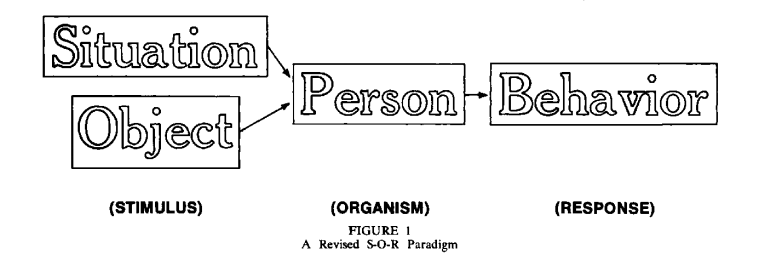
An early model of understanding consumer behaviour was introduced by Belk (1975), based on a stimulus, organism and response. The stimulus an object and a situation, a person (consumer) is the organism and the response to their behaviour (consumption).

consumer behavior model

Factors that influence consumer behaviour

Consumer behaviour is not static. It changes over a period and depending on the nature of products. Societal trends change, but also does an individual over their lifetime. Equally, all consumers do not behave in the same manner. Some people spend outside their means, others are quite frugal even if they do not need to be.

For many individuals, knowledge of consumer behaviour enhances their ability to consume more wisely. Given the time and energy we devote to consuming, we should aim to be better at it and have at least a basic understanding of how marketers try and influence our behaviour.


“Most of us spend more time buying and consuming than we do working or sleeping. We consume products such as cars and fuel, services such as haircuts and home repairs, and entertainment such as television and concerts.” (Hawkins & Mothersbaugh, 2010)


Some of the factors influencing consumer behaviour are:

  • Marketing factors such as product design, pricing, promotion, packaging, positioning and distribution
  • Personal factors such as age, gender, education, and upbringing
  • Psychological factors such as buying motives, perceptions and attitudes.
  • Situational factors such as physical surroundings, social surroundings and time factor
  • Social factors such as social status, reference groups, social media and family
  • Cultural factors such as religion and ethnicity
  • Lifestyle factors such as status, income and identity
  • Geographical factors such as region, country and urban or rural.

Indian student consumers

In a household, the whole family have influence and may become involved at various stages of the decision process, performing distinct roles.

For example, the mother is often the decision-maker, Dad the purchaser, but the children important influencers.

  • The Initiator -the person who proposes a brand (or product) for consideration (something in return)
  • The Influencer -someone who recommends a given brand
  • The Decider — the person who makes the ultimate purchase decision;
  • The Purchaser — the one who orders or physically buys it;
  • The User — the person who uses or consumes the product.

Some purchase decisions involve long, detailed processes that include extensive information search to select between competing alternatives. Other purchase decisions, such as impulse buys or habitual purchases, are made instantaneously with little or no investment of time or effort in information search.

All of this illustrates the many complexities of understanding consumer behaviour.


Why consumer behaviour is important to marketers

One of their biggest challenges for businesses is to stay relevant to their target market. We must ask questions of our customers such as:

Why do people buy and use certain products?

What do they buy, when do they buy it and how often?

What are their likes, dislikes and expectations?

Why do they decide to buy one product and not another?

Do consumers behave differently individually and in groups?

Consumer behaviour gives us a better understanding of what motivates consumers to make purchases, and the benefits most valued by them. Knowing what consumers value most will improve the decision-making of businesses when creating more effective marketing campaigns. Ideally to sell more! Marketing needs to be strategic to be at its most effective.


“Marketers spend billions of dollars attempting to influence what, when, and how you and I consume. Marketers not only spend billions attempting to influence our behaviour but also spend hundreds of millions of dollars studying our behaviour.” (Hawkins & Mothersbaugh, 2010)

For example, Procter & Gamble adding the word “repeat” to the instructions of their shampoo in the 1980s is a part of marketing folk law — not because it was required, but because it sold more shampoo.

Not only is consumer behaviour relevant to marketing strategy, but it is also important to research and development, management, sales and advertising.

Remember, marketing is not just advertising. It starts with marketing research — which helps us understand consumer behaviour in our market better, which then influences the product or service itself. We want to make it fit the needs of our target market as closely as possible, as it becomes easier to sell.

However, it is not an exact science. Consumer behaviour is difficult to predict. Applying the principals learnt from consumer behaviour knowledge requires human judgment, therefore is not an objective fixed set of rules.

Marketers must have a good understanding of consumer behaviour. The best way to do this is by using market research to study a range of factors that influence their target customers. Customer relationship management (CRM) statistics are an asset for the analysis of customer behaviour.

Consumption is the ultimate goal for marketers, referred to as a behavioural response. But marketing also aims to elicit an emotional (affective) responses, as well as a mental (or cognitive) responses, influencing a consumer’s thought processes. These are often antecedents for consumption.


“Consumer behaviour is of most importance to marketers in business studies as the main aim is to create and retain customers” (Kumar, 2004).

The benefit of understanding consumer behaviour

Understanding consumer behaviour habits of the target market enables marketers to take appropriate marketing decisions concerning the following factors:

  • Product design — If a company fails to understand the reaction of a consumer towards a product, there are high chances of product failure.
  • Pricing — what price is the target market most likely to purchase at? Is this profitable?
  • Promotion — where is the best place to reach the target market? Facebook? They might spend a lot of time reading car magazines. That would be a good place to put an ad.
  • Targeting — a group of consumers with the same or similar behaviour. Each group of consumers are different, their needs and wants different from other groups. Consumer differentiation will help to tailor your strategies to the needs of varying customer groups.
  • Packaging — what type and style of packaging will be most attractive to customers? Does it matter?
  • Positioning — communicating a brand’s point of difference compared to its competitors, to the target market.
  • Branding — monitoring other brands in the customer’s consideration set to optimise planning.
  • Place of distribution — what location or type of store to sell a product or service?
  • Customer retention — retaining customers is cheaper than attracting new ones, so understanding what customers want is key to maintaining their loyalty.
  • Predicting changing trends and behaviours — consumer behaviour changes, especially with fast-evolving technology. A consumer behaviour analysis will indicate a shifting trend so marketing efforts can be aligned accordingly.
  • Innovating new products and staying relevant — many new products and services end up in failure. It can range from 33% to 90% based on the industry. Understanding customers helps businesses to design offerings that will be consumed.


Buyer decision process

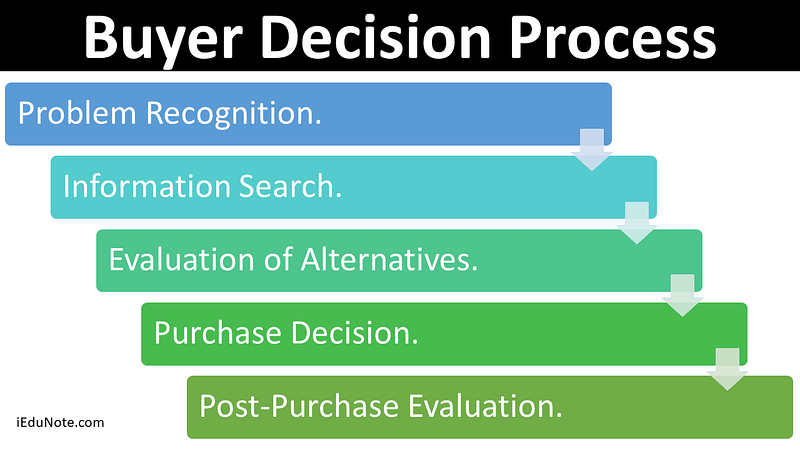
The buyer decision process (or customer buying process) helps marketers to better understand consumer decision-making and how the journey from knowing about a product to making the purchase decision is completed.

The process consists of 5 distinct stages: problem or need recognition, information search, evaluation of alternatives, purchase, and post-purchase behaviour/evaluation.

Buyer decision process

Problem recognition

The buyer decision process begins with the problem recognition stage, occurring when the consumer identifies a need or want. The strength of the need drives the decision process and the consumer decides they need a product or service to satisfy this desire. Triggers of problem recognition include:

• Out-of-Stock/Natural Depletion — e.g. when you run out of toilet paper

• Regular purchase — e.g. purchasing a bottle of wine each week with the groceries

• Dissatisfaction — e.g. not happy with their current internet service provider and change to a new one.

• New needs/wants — as a family gets bigger, they purchase a bigger vehicle

• Related product — purchasing on product triggers need for accessories, spare parts or complementary products such as purchasing the latest X-Box gaming console and upgrading the TV, buying games to go with it, and extra controllers.

• Marketing induced — advertising triggers the recognition of a problem or needs that consumers did not realise they had. E.g., my internet IS slow. Yes, I do need faster internet!


Information search

The information search phase aims to identify a list of options representing realistic buying options. Consumers search their internal memory and use external sources for information about options that will potentially satisfy their need. In an internal search, the consumer scans their memory for suitable brands.

The evoked set are preferred brands, typically to around 3- 5 alternatives.

Businesses use marketing to increase brand awareness and the likelihood that their brand becomes a part of their target market’s evoked set. An understanding of their target market’s behaviours means they are can be more objective with putting marketing in places where they are more likely to see it and hopefully remember it.

External sources of search include the internet such as social media or product comparison websites, shopping around and talking to friends/family.

Information search and the next phase of evaluation can occur throughout the entire decision process.


Evaluation of alternatives

Consumers engage in a series of rational evaluations of the alternative options available to them. During this evaluation phase, consumers consider a small number of options that could be viable choices.

Being aware a brand exists does not necessarily mean it will be considered as a potential purchase. Realistic purchase options are known as the consideration set, each consumer will have distinctive characteristics they are looking for, searching for the best value and the best fit for their needs.

Different evaluation criteria are used depending on each unique buying situation, consumers assessing and then ranking the relative merits of different options available. Consumers with low knowledge about a product category tend to evaluate a brand based on functional characteristics.

Towards the end of the evaluation stage, consumers form a purchase intention.


Purchase decision

Once the alternatives have been evaluated, the decision is made by the consumer and they proceed through to the actual purchase. To increase the chances of customers purchasing with them, businesses use techniques to improve conversion rates, such as a strong call-to-action in advertising. “Buy now while stocks last!”. This encourages an immediate sale.

Some customers might know all along who they want to purchase with. Others might spend an extended period researching information about the different options available before they make their decision.


Post-purchase evaluation

This process is not complete until after the consumption of the product or service and the consumer engages in a post-purchase evaluation. Consumers compare their experience with the product or service and the perceived value with their expectations that were formed during information search and evaluation. This is called expectancy disconfirmation and is a strong driver of satisfaction.

Factors evaluated include price, functionality, and quality.

A consumer’s next purchase decision for that good or service is influenced by this evaluation. If consumers feel some uncertainty or regret towards their choice, they are unlikely to choose that brand again.


Consumer motivations

An underlying motivation drives a consumer to act and purchase. These motivations fit under the problem recognition phase discussed above.

This motivation can be either positive or negative. A positive motivation could be a pleasure — having dinner a nice restaurant or a night on the town.

A negative motivation could be the avoidance of unpleasantness such as purchasing toothpaste to minimise tooth decay, getting toothaches and having to visit a dentist.

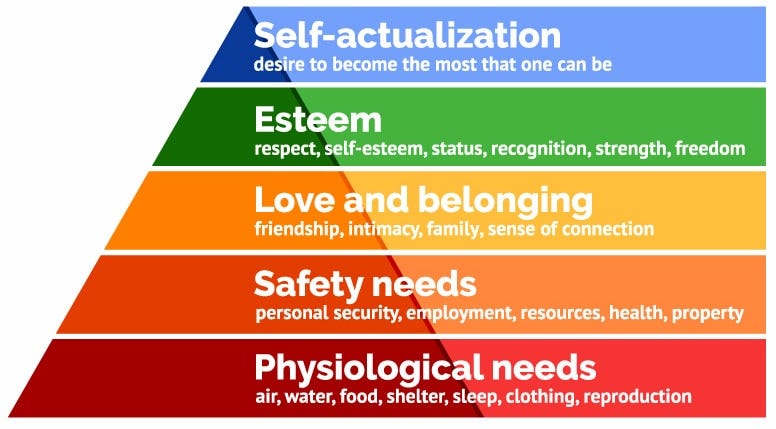
Abraham Maslow’s well-known Hierarchy of needs model is one way to help understand the motivation.

Maslow's hiararchy of needs

Although not a marketing model, it is commonly applied across the social sciences. This model can help marketers to understand the unique needs and levels of motivations of customers.

It contains five levels of needs, organised accordingly to the level of importance. Lower order needs are most important, consumers typically using most of their time, energy and finances attempting to satisfy these.

Only then can they move onto the higher-order needs and they become meaningful.

  • Physiological is a human’s basic levels of needs such as food, water and sleep. We need these to survive.
  • Safety is the need for physical safety, shelter and security. Purchasing a house or paying rent.
  • Belonging the need for love, friendship and a desire for group acceptance. A man buys his new wife an expensive ring when they get married.
  • Esteem is the need for status, recognition and self-respect. Purchasing the latest BMW car or a designer handbag and shoes.
  • Self-actualisation is the desire for self-fulfilment such as personal growth or artistic expression. You might over to the other side of the world to see a motivational speaker such as Tony Robbins at a conference.

Using Public Relations to Influence Your Audience's Perceptions


The use of the media to influence the perceptions of vast audiences has long been used by governments and corporations.

This is called public relations (PR), where the media is used as a gatekeeper for releasing a story to the wider public.

However, over the past 20 years or so in the age of the internet and social media, the average business or individual now has access to PR without needing a connection in the media or a big budget to pay a PR company to gain exposure.

This blog explores the use of public relations as a part of a marketing strategy.


What are Public Relations?

Public relations (PR) is the manages the release and spread of publicity from a firm or individual to the public to influence their opinions, attitudes or behaviours. PR aims to build and maintain relationships with stakeholders and those who influence the target audience, to enhance the public reputation.

Public relations professionals are storytellers and image shapers who create a positive narrative for their clients by working closely with journalists and other media. This allows them to manage and generate positive publicity for their clients to enhance their reputations. 

Public relations are controlled internally as a strategy, but publicity is controlled and distributed externally.

“(Public Relations) helps establish and maintain mutual lines of communication, understanding, acceptance and cooperation between an organisation and its publics; involves the management of problems and issues; helps management keep abreast of and effectively utilise change.” (Harlow, 1976)

PR has been a profession since the dawn of the 20th century, but the roots of the idea of widely influencing public opinion and action can be found and during the movement to abolish slavery in England 100 years before that. 

Because of these beginnings, one of the underlying assumptions of PR is that it should be socially responsible and go beyond organisational goals to play a constructive role in society.

Depending on the situation, PR will have a particular tone — whether it is showing empathy and understanding, storytelling and creativity, or more persuasive messaging. Messages are tailored to the relevant target audience/s.

PR applies to all organisations from small businesses to corporations to governments or activists. They could be from the private, public or third sector. The third sector is an umbrella term for voluntary and community organisations such as social enterprises.

Some of the tools used for PR are:

  • Owned media (e.g. website)
  • Earned media (e.g. newspapers)
  • Shared media (e.g. social networks)
  • Sponsorships and fundraising
  • Face-to-face
  • Photography
  • Moving images (video)
  • Print (e.g. newsletters)
  • Events (e.g. conferences)
  • Public Speaking

Publics

Public Relations is a critical link to manage communications between a firm or person and its publics. ‘Publics’ is any group of people or stakeholders who have a common interest in a particular subject.

Some of those publics are:

  • Employees (and potential)
  • Suppliers (and potential)
  • Partners
  • Distributors (and potential)
  • Investors
  • Donors
  • Political audiences, decision-makers and other opinion formers
  • Media and other commentators
  • Social media influencers
  • Customers
Newspaper article - Public relations

Objectives of Public Relations

Public relations can be used to protect, enhance or build reputations. 

The “management of communications between an organisation and its publics.” (Grunig, 2013)

The goal is for firms or individuals to establish, build, nurture and maintain trusted relationships with their target audience.

Communication tactics are planned and executed to influence peoples’ attitudes and behaviours, ultimately to maintain or foster a positive opinion of the firm or person.

Much like marketing, PR has several individual activities and can have distinct goals. The intended audience could be prospective customers, investors, partners, employees, or just the general public.

Some of the objectives of PR are:

  • Increase brand awareness: inform the public of the policies, procedures and interests of a firm, promote an idea, or recognise accomplishments.
  • Crisis communication: managing a company’s reputation when negative news is public, formulate a response and ease the damage.
  • Internal communications: communicating within the company itself, employee relations.
  • Government relations & lobbying: public affairs is engaging and interacting with the government to influence public policy.
  • Media relations: building and maintaining close relationships with the news media.
  • Social Media/Community Marketing: leveraging social media marketing to distribute messages to desired target audiences.

Public relations strategy

PR is a strategic communication process, and a strategy often begins with an idea to create a story that would be of interest to the general public and will leave a positive impression for the company or individual. 

A second way could be to follow up with a comment on the latest news or a current event connected to the firm/person or the industry they are in.

“Public Relations is a strategic communications process that builds mutually beneficial relationships between organisations and their publics” (Grunig & Hunt, 1984)

A PR message might be prompted by a piece of news, but a PR strategy is deliberate and should begin with an analysis of the organisation to pinpoint strengths or opportunities to guide the positioning of the strategy and messaging.

A PR strategy should be actively managed and grounded in research, to gain an understanding of the environment that shapes decision-making. Messages that are consistent with organisational values and goals, but also consistent with public values and goals is key.

The interests and concerns of the company’s stakeholders should be acknowledged in the strategy — listening to their concerns to build a mutually beneficial relationship. To avoid having contradictory or confusing messages, there must be consistency in the overall message and theme.

Several distinct but complementary messages are created to target different audiences. For example, a charity event. One message would be crafted towards the general public, and one message crafted towards corporate sponsors. 

There’s the same goal of a successful event that raises lots of money, but there are different value propositions for somebody paying to attend the event and enjoy a night for a good cause, to a corporation wanting to increase their brand awareness.

“The overall planning, execution and evaluation of an organisation’s communication with both external and internal publics — groups that affect the ability of an organisation to meet its goals.” (Grunig, 2013)

PR activities

There are several activities and tools that businesses can use for PR. There used to be a reliance on media companies and PR firms to use media such as TV and magazines to reach a certain target audience. The internet has created several opportunities for businesses to do their own PR.

Firms or individuals can produce and share content via social media to respond to a circumstance or to enhance brand awareness with their target audience.

Some of the individual PR activities that businesses can use include:

  • Writing and distributing press releases
  • Managing internal communications
  • Arranging interviews for company spokespeople
  • Holding press conferences and media interviews
  • Speechwriting
  • Writing and sharing story pitches directly to journalists
  • Hosting or sponsoring events
  • Personal networking
  • Writing blogs and newsletters
  • Social media promotions
Speech writing - Public relations


Is public relations marketing?

Public relations have become a component of marketing over the past 20 years or so since social media started being used for press releases. 

The fragmentation of mass media has dissolved a lot of the barriers public relations had for small businesses and PR has shifted into more interpersonal channels of communication. 

PR can be used for market positioning and branding, aligning it with marketing goals.

The fundamental idea behind PR is for businesses to gain exposure to their target audiences using topics of public interest, this coverage received for free. Referred to as ‘earned media’, this is what makes public relations different from advertising. 

However, social media can blur those lines — a boosted post for example where a normal social media post becomes a paid ad.

Think of PR as the generation an article featuring a client, rather than having a paid ad next to the article. This positive story enhances reputation as it is more credible coming from a third party.

Some of the main differences between advertising and public relations are:

  • Paid vs Earned
  • Builds exposure vs builds trust
  • Visual vs language
  • Creative control vs Media control
  • The audience is sceptical vs media gives third party validation

Thank you for reading.

I hope you enjoyed this blog about public relations and how the media can be used as a tool to spread a positive message about a business or person, to influence public perceptions.

Dan.

This blog was originally posted on the BYB Marketing blog.

Using Differentiation to Stand Out From The Competition

Differentiation strategy

If we’re the same as everybody else, nobody will remember us. If we’re a brand, we want to be memorable, right?

We want people to think of us when they are thinking about purchasing a product or service that we offer.

If we have a point of difference to our competitors, we are more likely to be remembered. We also want to offer a unique benefit that our competition does not offer.

This week’s marketing blog, this article explores differentiation as a business strategy.

Hashtags: How to Use Them to Engage Your Audience

 hashtags

Anyone browsing Instagram is bombarded with hashtags, but how much purpose do they serve on Social Media? Is less more?

If you browse through Instagram, Twitter or even LinkedIn, no doubt you will come across hashtags. 

They could be used to define a topic like #Marketing, or it might be something a bit more random like #Dansmarketingtips.

But what do they actually do? What is the benefit of hashtags?

Is there such a thing as too many hashtags? 

Yes, there is — and here’s why.


What is a hashtag?

A hashtag is a keyword or phrase preceded by a hash (#). North Americans also refer to the hash symbol as a pound symbol (also an octothorpe), and the original use was to mark numbers.

“Hashtags have been seen as a way of increasing the communicative reach of a social media text by attracting a great audience who might ‘engage” with a post.” (Zappavigna, 2018)

Vastly popular on social media, these hashtags help a piece of content become more discoverable by other users. It is a form of social tagging to embed metadata in posts. Social tagging is “the act of annotating a digital text with user-generated tags so that other users can find it” (Zappavigna, 2018); whilst metadata summarizes basic information about data. A small piece of data about a bigger piece of data!

This social metadata facilitates ‘real-time’ search, which is an essential function of social media. It allows users of a social media website to find other posts containing that keyword. Twitter marketing specialist Chris Messina sent the first-ever tweet containing a hashtag in 2007 after pitching the idea to his bosses to help group related Tweets (posts) together.

Because of the character-constrained aspects of Twitter (also called microblogging), a hashtag was an uncomplicated way to provide more context for a post without using too many characters. The decision to use the # symbol as it was easy keyboard character to reach on a Nokia phone at the time (remember when people used Nokias!?)

Hashtags have since become popular and spread to other social media platforms such as Facebook, Instagram, and LinkedIn, and have even to television and advertising. Some tags have short life cycles if they are based on a trend or cause, while others are relevant over an extended period.


Functions and benefits of using hashtags

The use of hashtags has grown from the initial purpose of indicating the topic of a post to support visibility and participation, to having the additional function of a social resource for forming relationships and communities. Social media users now commonly use hashtags to give interpersonal meanings to a piece of content. Because users choose their hashtags, they inevitably have become personalised and can even start trends. These two broad functions of hashtags providing numerous benefits.

“Hashtags operate as social metadata in the sense that they are a form of descriptive annotation produced by users, rather than assigned by the microblogging service.” (Zappavigna, 2015)

Indicate topics or themes

Hashtags are an information-organising tool in the same way as keywords are for search engine optimisation (SEO). They add context to a social media post and act like a “decentralised, user-generated tagging, organising, and classification system” (Saxton, Niyirora, Guo, & Waters, 2015). A piece of content is classified into a specific topic, theme or conversation. For somebody browsing their feed, a hashtag might capture a user’s attention enough for them to engage in the content, if the topic is of interest.

Help your target audience find you

Hashtags enhance the searchability of content, by helping people find more content about a topic of interest. Accordingly, it helps a brand create content that their target audience can find.

With an added hashtag, a post becomes indexed by the social media network. People who search that hashtag can then find your content even if they are not following you — using highly searched popular hashtags helps a new audience find your brand. Some social networks even let users follow hashtags to help curate what kind of content they see in their feed and make sure it is relevant.

Interpersonal hashtags

Social media users now often use hashtags to portray an attitude towards a certain topic or current affair. For example, #getoverit or #supportlocal. Hashtags like this are used to engage with other users and form relationships. These are interpersonal functions — the motivation of asserting opinions and negotiating relationships.

This goes against the original function of hashtags, as they provide no value for making a post more findable. However, this makes sense as most social media users are not trying to grow an audience, they want to engage with others. It can show social affiliations, or it can be emphasizing a humorous observation.

“Hashtags remain a popular means of coordinating social media discussion, referencing ideas, cracking jokes and producing metacommentary… The act of tagging, once an act of classification, has emerged as a means of forging and contesting social bonds.” (Zappavigna, 2018)

Hashtag communities & branded hashtags

Popular hashtags and especially those created around a specific cause or event often have communities developed around that hashtag. Large scale participation in the sharing of memes, for example, #nekminnit (only New Zealanders may know that one). Organisations can create these hashtags for a specific cause to help raise awareness, such as #BLM or #BlackLivesMatter.

Creating a personalised branded hashtag can be an effective way to start conversations, personalise your content and make it easier to find. This is a great way to grow your personal brand.

For example, I hashtag some of my LinkedIn content with #brandwithdan, so if people click on that hashtag, they find more of my content about marketing. I run a networking event called LinkedIn Local Hamilton, and I hashtag those posts with #LinkedInlocalHamilton, so people can find more event content. If people start to follow those hashtags, they automatically get their content. The goal is to start communities around these branded hashtags. But do not use too many, one a post is enough.

“These networks/communities can be ephemeral and arise in response to emergencies and crises, or they can be more stable, long-term communities of practice or knowledge that develop to spread ideas, news, or opinions on a given topic.” (Saxton, Niyirora, Guo, & Waters, 2015)

How to choose hashtags

Now we know the benefits of using hashtags, here are some guidelines to help get the best result from using hashtags. Stuffing a post with 20 random hashtags such as #likeaboss or #dansrandomthoughts is not going to do a post any good. Choosing the right hashtags can be quite strategic. At one end of the scale is using random personalised hashtags that nobody would search for is at one end of the scale, while at the other end are generic and common hashtags.

Just using the most popular hashtags is not going to do much good either. For example, if a hashtag has 10 million search results, then the chances of people finding your content are extremely low. They also do not add much meaning to a post or say much about your brand. Use these popular hashtags sparingly.

The first way you can research hashtags is to check out relevant influencers in your niche as well as your established competitors and see what hashtags they are using often.

There tools such as Hootsuite, that analyse current social media trends and what hashtags are the best fit for your brand. Other research tools that will help you find relevant and effective keywords in your niche are RiteTag and Hashtagify.me


Hashtags best practice

Knowing how to use hashtags will help boost your brand’s social media engagement. The annoying part is that every social media platform treats hashtags slightly differently. However, some general rules apply across platforms.

People can use a hashtag anywhere in a post — in the body of text to emphasise a certain keyword, or at the end to provide context to that post. You cannot use spaces, punctuation or symbols in a hashtag. Posts must also be public — if it is private, only followers can find the post, defeating the purpose. Also, do not string too many words together — the best hashtags are short and easy to remember. If a word is difficult to spell, it will not make for a highly effective keyword either. Detailed and specific hashtags will lead to better results than broad ones.

More is not better when it comes to hashtags, contrary to widespread belief. The world of Instagram has popularised the use of numerous random hashtags across other platforms, even though they provide no benefit or function. Some people on LinkedIn finish a post with 10–20 personalised hashtags. To me, it just seems vain and spammy. Some platforms even penalise content for using too many.

Limit the number of hashtags you use. More is not always better. It looks spammy and people tune out from spam.

social media

Here are some guidelines for hashtag use on the major social media platforms.

Twitter

Research has shown one to two hashtags on Twitter is optimum. Engagement reduces when you include more than two. It can be valuable to search hashtags to find conversations related to your niche to be involved in — type the hashtag into the search bar. You can also click on explore and then trending, to find current ‘hot’ hashtags, use any that are relevant to your content to reach a wider audience. People and businesses can also add hashtags to their bio/profile.

Facebook

On Facebook, it is again important not to use too many hashtags. One or two is the recommendation again. There is no real use in using them on your private personal account as people who are not friends will not find your content, but on a public business page, they can. Because of the privacy of personal accounts, it is also hard for brands on Facebook to monitor the performance of branded hashtags.

Inside Facebook groups, hashtags are useful for grouping together content by topic.

LinkedIn

Hashtags have only been utilised by LinkedIn over the past few years. LinkedIn does not have privacy on personal accounts which means there is a lot of value in using hashtags to make content more findable by people outside your network.

Two to five hashtags are the recommendation, and the first three used in the posts URL to help with search engine optimisation. LinkedIn even suggests keywords for you when you write a post and you can also follow hashtags. Use one personally branded hashtag so people can follow your content is beneficial but use specific hashtags that indicate the topic of a post for your others.

Instagram

Using multiple hashtags on Instagram is more embraced than any other social media platform and even encouraged. In posts, you can use up to 30, but around 10–12 is the sweet spot. In stories, you can use up to 10. People do not use hashtags as a keyword as was their initial intention on Twitter, instead, hashtags such as #picoftheday and #instadaily have become some of the most popular hashtags. Hashtags are more lifestyle based.

Unlike other platforms, people on Instagram often use hashtags in their comments. Because of the vast number of content (over a billion users) and keywords, it is important to know what hashtags are popular in your niche. They are likely to be far different to LinkedIn for example. You can also use hashtags in your bio, so use them more like a keyword there.

YouTube

As well as adding tags to a video on YouTube, you can also use hashtags in the title and the description. Clicking on one of these hashtags helps a user find more content with that hashtag. Again, there is no point using random personalised hashtags, instead, use them as a keyword. The optimal number of hashtags to use is less than 10, and YouTube will penalise any video that uses more than 15 — ignoring the hashtags and the post may be flagged. YouTube views this as spam. If you do not include hashtags in the title, the first three hashtags in the description will show above the title of your video.


That is the lot for this week’s blog about Hashtags. I hope you learnt something new about Hashtags and implement some changes into your social media strategy that helps you get more engagement.

#Seeyounextweek,

Dan.

This content was originally posted on our website blog.

Influencer Marketing in 2020 - Are We Sick Of It Yet?


Influencer Marketing is one of the biggest marketing trends for the past five years. 

If you spend much time browsing Instagram or YouTube, no doubt you will have come across an internet celebrity with a sponsored post or product placement promoting some random brand. 

So how does it all work?

Are Influencers still relevant? 

Or are we getting sick of unauthentic posts from celebrities endorsing a product they don't use? 

What is Influencer Marketing?

Social media influencers are individuals who create content promoting certain brands through social media sites like Instagram, YouTube, Twitter, and Facebook. This is a marketing strategy used by brands who hire these influencers to increase their interactions with their target customers online, increasing their brand awareness and recognition, increasing sales.

These influencers have built a following online through their prominent personal branding.
“Influence can be broadly defined as the power to affect a person, thing or course of events. Influence manifests itself in many ways, from direct purchase advice to subtle shifts in perception of a vendor’s credibility.” (Brown & Hayes, 2008)
Influencers are people who have built a reputation online for their knowledge and expertise on a topic or lifestyle or because of their status. This reputation gives them social influence in their specific niche or area of expertise/fame, their followers taking note of their actions and opinions.

An influencer taking a selfie

Unlike celebrities of the past who often lead very private lives, influencers give followers access to a snapshot of their personal lives. This glimpse into the good life creates a bond and helps influencers to win the trust of their target audience.

These social relationships become assets for influencers to collaborate with brands to help them reach their marketing goals, as they have the power to affect the purchase decisions of others through their authority and trust of their following. This provides credibility for brands with a shared target audience.

Social media uses love to feel like they can relate to the people they respect and follow. What better way of doing this than consuming the same products? Because of this, social media influencers can often create trends.

Influencers post content on their social media accounts to advertise the brands through product reviews and endorsements and commonly use product placements. This application of a brand into a “real life” situation (social media is often a little staged) entices their audience to view the product positively.

An influencer can have as little as 1,000 followers, or the top celebrity influencers now have hundreds of millions. Portuguese professional footballer Cristiano Ronaldo is the biggest, now at almost 240 million followers.
“Social media influencers represent a new type of independent, third-party endorsers who shape an audience’s attitudes through blogs, tweets, and the use of other social media channels.” (Freberg, Graham, McGaughey, & Freberg, 2011)

The Benefits of Influencer Marketing

The major drawcard of using influencers in a marketing strategy is their ability to give a brand a wider audience online. The following statistics are an indication of the effectiveness of influencer marketing:
  • 92% of marketers surveyed believed influencer marketing is effective at generating and converting leads in generating leads (Influencer Marketing Hub).
  • One study found that every $1 spent on influencer marketing produced an average return of $18 (Oberlo).
  • 80 percent of consumers surveyed had purchased a product after it seeing it in an influencer’s post (Oberlo).
The use of social media influencer marketing as a public relations and marketing strategy has removed many of the barriers between consumers and brands, changing the way they interact. Brands use influencers as a tool to attract and enhance relationships with their target audience, as many social media users use influencers to help guide their target market with their decision making.

The trusting relationship followers have with influencers means their recommendations are almost as trusted as a recommendation from a friend — one study found “56% of users surveyed said they rely on recommendations from friends, while 49% said they rely on influencers” (See Woods, 2016). 

This recommendation from a trusted influencer strengthens a brand’s credibility and reputation, which can form a relationship with the brand.

Influencers help to increase brand awareness of their clients and broaden their audience through the exposure of the brand to their followers. Brands need to choose a relevant influencer who is popular and relevant to their target audience. They give brands a fresh perspective, as they are already regularly creating unique and engaging content for their audience. Their audience perceives this marketing content as more credible and authentic than traditional advertising due to the trust the influencer’s following has.

Brands can now target audiences through influencers that were previously unreachable through mass marketing. Nano and Micro-influencers often have strong followings and credibility in niche markets and communities that traditional marketing cannot reach.
“You log onto Instagram and a celebrity confesses their love of Chipotle with a burrito in their hand. Later you are scrolling through Twitter and one of your friends tweets an image with their Starbucks Frappuccino. Both of these are examples of influencer marketing, the only difference being the first one is paid by advertisers and the second is not. This blurring of the lines between what is a genuine endorsement and what is a paid one through content-rich platforms is what makes influencer marketing so powerful.” (Woods, 2016)

How is influencer marketing so effective?

Social media has broken down the barriers between been brands and their consumers. Influencers have made this even more of a two-way relationship, where previously advertising was one very one way.

influencers promote brands by using them in their personal lives, it does not seem like advertising. The product placements they use in an everyday setting makes brands seem more relatable to consumers. In this sense, influencers serve are a connector between a brand and a consumer.

Through openness and honesty in their social media content, influencers seem authentic, giving them credibility with their audience (We’ll talk about this further later).

Social media followers learn from the example of influencers, and through this observation, people have a higher likelihood of adopting those behaviours. Social Learning Theory (see Bandura, 1969) proposes that people can develop new social behaviours through observing and imitating others.

Electronic Word of Mouth can also explain why using influencers is so powerful — this is any positive or negative statement made about a product or brand online. Word of mouth is one of the most credible and trusted sources of marketing and helps form consumers’ opinions on products and services. Consumers are more likely to have a positive perception of a message from a friend or a trusted influencer than a sponsored post that comes from a company.

Types of Influencers

Not every influencer has celebrity status. There are four broad categories of influencers:
1. Celebrities
2. Industry experts and thought leaders
3. Bloggers and content creators
4. Nano, Micro & Macro Influencers

Celebrities

The top tier of influencers is celebrities. They could be sports stars, actors, pop stars or just people who are famous for being famous. The Kardashian and Jenner family the perfect example of the latter, with three of the family (Kim, Kylie and Kendall) in the top 10 most followed on Instagram.

These celebrity influencers typically have more than a million followers and tend to have a wide range of followers rather than in one niche. The cost to use this celebrity influencers is extremely high, and their followers are not as defined — they often come from all walks of life.


Top 5 Instagram Influencers in 2019 (https://hypeauditor.com/top-instagram/)

top 5 influencers

Industry Experts and Thought Leaders

Influencers can also gain their status by gaining it through their qualifications, position, or experience in their area of expertise. They often gain this reputation and respect through having a prominent role in the workplace. For example, although now you could almost consider her a celebrity, New Zealand’s Prime Minister Jacinda Adern, has a large following on LinkedIn and Facebook.

These experts and thought leaders include journalists, CEOs at large corporations, academics and industry experts.

Content Creators and Bloggers

Content creators are everywhere on YouTube, Instagram, TikTok and even LinkedIn. They typically post a variety of informational content about a topic of interest and build a following through this. These influencers differ from industry experts as they are not in a position of power or have widespread credibility because of their professional reputation. They can be small business owners or just passionate about a certain topic.

One such niche which is growing in prominence is gaming. Gaming influencers live-stream their games over YouTube or other video platforms and their fans watch to get better at the game. Brands can promote products and offers through these streams to generate sales. For example, a headset or controller brand. 

A gaming influencer called PewDiePie has over 100 million followers on YouTube.

Bloggers publish content on topics such as travel, marketing, fashion, lifestyle or business and promote their blog content across various social media platforms. Those with a large following become a credible authority in their niche so their audiences are likely to trust their recommendations.

Nano, Micro and Macro Influencers

Nano and Micro-influencers are the other end of the scale from Celebrities. Nano influencers have small followings of under 10,000 and Micro-influencers are the next tier up with between 10,000 to 10,000 followers.

These influencers are typically are normal people with normal jobs, who have become well known because of their content and knowledge in a specific niche. They are credible and their social media following are people interested in that niche and engage often in their content. They have a strong relationship with their following and because of this, they usually do not want to harm their reputation through promoting something that does not fit.

They are likely to become vocal and loyal advocates for a brand and their audience are more likely to perceive their recommendations as an authentic testimonial, instead of the branded endorsement of a celebrity.

These influencers are perfect for small businesses with modest marketing budgets.

Macro Influencers sit between Micro-influencers and Celebrities, sharing characteristics of both, usually having a following of between 100,000 and 1 million people. A bigger audience than micro but not the same loyal following. Often Macro Influencers found their fame online, through being a content creator on YouTube for example.

Current Influencer trends for 2020 and beyond

The use of influencer marketing has exploded over the past five years. But there has recently been some backlash against influencer marketing (more about that soon), however, the online search for “influencers” search term itself has seen a 1500% increase between 2016 and 2019 (https://influencermarketinghub.com/). This shows influencer marketing still has a massive relevance to businesses.

There are still plenty of businesses investing in influencer marketing according to Oberlo:
  • Nine out of 10 marketers believe that influencer marketing is effective
  • 93% of marketers used influencer marketing in 2019
  • 57% of marketers plan to increase their influencer budgets in 2020.

Influencer Fatigue

Even though social media users know that brands pay influencers for their endorsements, many are still able to remain a trusted and authentic source to their followers. However, this is starting to change. People are getting sick of plastic and unauthentic social media posts that are obviously staged, where a promoted product is different from an influencer’s niche that they do not even use it. 

Why would you trust somebody just saying something just for the money?
influencer cartoon

The growing demand for authentic content from Gen Y and Z has means that some brands are starting to move away from the use of influencers. They want REAL content and that is what they enjoy engaging with.

‘Faking’ Influence

The use of fake followers and likes has become increasingly more widespread, where a person pays for artificial engagement and growth to boost their social media accounts. Bots often used to inflate these numbers — Numerous influencers were caught using these services. This artificial following used to ‘trick’ brands into collaborating with them

I too have been approached many times by direct message on Instagram, asking if I want to increase my number of followers and get a certain amount of likes per post, for a fee.
“For social media influencer’s whose focus is on lifestyle branding, authenticity is key… The influencer being genuine, honest, and open with her followers. Authenticity allows an influencer to relate with followers on a new level and aids in building a relationship between followers and brands.” (Glucksman, 2017)

Celebrity Influencers are out, Nano-influencers and Micro-influencers are in

The influencer game is changing. Celebrity influencers are no longer as popular as they used to be, as brands move toward the use of teams of micro-influencers instead of using one or two celebrities. Nearly 80 percent of the brands surveyed by Linqia said they want to work with micro-influencers in 2020.

Celebrity influencers require a large pay-check, sometimes of hundreds of thousands or even a million dollars per social media post. If the content does not come across as authentic, then the return on investment is not going to be as high as using micro-influencers with a more genuinely engaged following.

Contrasting the perfect image portrayed by many celebrity influencers (how can that be real?), micro and nano influencers create content that is not glamourous or staged. This is a lot more believable.

Influencers are employed for their ability to influence people. Not just because they have a following. Having the ability to influence the decision-making of consumers in a niche is key.

Businesses must weigh up an influencer’s following with their credibility with their target audience.

The internet has allowed the fragmentation of media into small niches and communities. Because of this, Nano and Micro-Influencers are becoming more attractive; with their penetration into these communities where they have engagement and credibility.

The use of Employee Advocates as influencers

A study by MSL Group suggests that brand messages are re-shared 24 more often when distributed by employees than by the brand itself.

Employees can be immensely proud of where they work and happy to spread positive messages about their company and brands. They live and breathe the brand, so often have the tremendous insight they can share that does not come across as staged or inauthentic and they become the perfect candidate for an influencer. Therefore, businesses should encourage their staff to be advocates — especially on a platform like LinkedIn. 

They might not have much of a following, but it costs nothing, and a team of enthusiastic staff can have as much reach as one or two paid influencers in their niche.